
A beginner’s guide to Vata, Pitta, and Kapha — and why knowing your dosha can change how you eat, sleep, and live
What Is a Dosha?
In Ayurveda, the 5,000 year old system of medicine from India, everything in the universe, including your body, is made of five elements: Space (Akasha), Air (Vayu), Fire (Agni), Water (Jala), and Earth (Prithvi) .
These five elements combine in pairs to form three biological energies called doshas.Think of doshas as the operating forces that run your body — not something mystical, but a working model of physiology that Ayurveda uses to explain how you digest food, think, move, and heal.
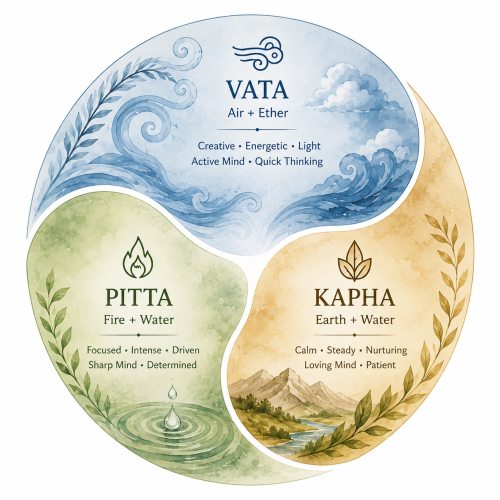
- Vata = Space + Air → governs movement
- Pitta = Fire + Water → governs transformation
- Kapha = Earth + Water → governs structure
Every person has all three doshas in some proportion. But usually, one or two dominate, and this is called your Prakriti, or natural constitution. Your Prakriti is set at birth and doesn’t change; what changes daily, seasonally, and with lifestyle is your Vikriti- your current state of balance or imbalance.
The Three Doshas Explained
Vata: The Energy of Movement
Vata controls anything that moves in the body: breathing, blinking, muscle movement, heartbeat, and the flow of thoughts.
Physical traits of a Vata dominant person:
- Thin, light frame; finds it hard to gain weight
- Dry skin and hair
- Cold hands and feet
- Irregular appetite and digestion
Mental/emotional traits:
- Quick thinker, highly creative, learns fast — but forgets fast too
- Enthusiastic and energetic in bursts
- Prone to anxiety, worry, and overthinking when imbalanced
Signs of Vata imbalance:
- Constipation, bloating, gas
- Insomnia or disturbed sleep
- Anxiety, restlessness
- Dry skin, joint cracking, fatigue
Pitta: The Energy of Transformation
Pitta governs digestion, metabolism, and how the body converts food into energy. It also governs mental “digestion” i.e. how you process information and emotions
Physical traits of a Pitta dominant person:
- Medium build, athletic
- Warm body temperature, often feels hot
- Strong appetite and digestion
- Prone to acne, rashes, or premature greying
Mental/emotional traits:
- Sharp intellect, natural leader, goal oriented
- Good decision making skills
- Prone to irritability, anger, and criticism when imbalanced
Signs of Pitta imbalance:
- Acidity, heartburn, inflammation
- Skin rashes or excessive body heat
- Anger, frustration, impatience
- Excessive hunger or thirst
Kapha: The Energy of Structure
Kapha provides the body’s structure, lubrication, and stability. It governs immunity, joint health, and emotional groundedness.
Physical traits of a Kapha dominant person:
- Solid, sturdy build; gains weight easily
- Smooth, oily, thick skin and hair
- Slow digestion, steady appetite
- Great physical stamina and strength
Mental/emotional traits:
- Calm, loving, loyal, patient
- Excellent long term memory
- Prone to attachment, lethargy, and resistance to change when imbalanced
Signs of Kapha imbalance:
- Weight gain, water retention
- Sluggish digestion
- Oversleeping, low motivation
- Congestion, mucus buildup\
How Do You Find Out Your Dosha?
Classical Ayurvedic texts like the Charaka Samhita and Ashtanga Hridayam describe dosha assessment through:
- Physical examination — body frame, skin, hair, eyes, nails, and pulse (Nadi Pariksha)
- Behavioral patterns — appetite, sleep, energy levels, stress response
- Personal and family history
While many online quizzes offer a quick estimate, a consultation with a qualified Ayurvedic practitioner gives a far more accurate picture, since dosha assessment blends observation, pulse diagnosis, and detailed questioning — something a questionnaire alone can’t fully replicate.
Most People Are Not “Pure” One Dosha
A common myth is that everyone is purely Vata, Pitta, or Kapha . In reality:
Most people are dual dosha dominant (e.g., Vata Pitta or Pitta Kapha)
A rare few are tridoshic, with all three in near equal balance. Your dominant dosha isn’t “better” or “worse” — it’s simply your baseline
The goal of Ayurveda isn’t to change your dosha. It’s to keep your unique combination in balance .
Why Doshas Go Out of Balance
Ayurveda teaches that imbalance (Vikriti) is usually triggered by:
- Diet — foods that aggravate your dominant dosha
- Season — Vata rises in autumn/early winter, Pitta in summer, Kapha in spring
- Lifestyle — irregular sleep, excess stress, overwork
- Age — Kapha dominates childhood, Pitta dominates adulthood, Vata dominates old age
- Time of day — each dosha has peak hours (e.g., Kapha 6–10 AM, Pitta 10 AM–2 PM, Vata 2–6 PM)
Understanding these natural cycles is central to Ayurvedic lifestyle planning, or Dinacharya (daily routine).
Simple, General Balancing Tips
* These are general wellness principles, not a substitute for personalized advice.
To balance Vata:
- Favor warm, cooked, moist foods over cold or raw ones
- Keep a regular daily routine
- Practice grounding activities like yoga or gentle walks
To balance Pitta:
- Favor cooling foods (cucumber, coconut, sweet fruits); reduce excess spice
- Avoid overexertion in peak heat
- Practice activities that reduce intensity, like swimming or moonlit walks
To balance Kapha:
- Favor light, warm, and spiced foods; reduce heavy, oily, or cold foods
- Stay physically active; avoid oversleeping
- Introduce variety and stimulation into daily routine
A Note on Modern Science and Ayurveda
Dosha theory is a traditional diagnostic framework, not a concept validated by modern biomedical research in the way, say, blood pressure or cholesterol are measured. Some modern studies have explored correlations between Prakriti types and physiological markers, but this remains an evolving area of research rather than settled science.
That said, many people find the dosha framework genuinely useful as a self awareness tool – a way to notice patterns in digestion, energy, and mood, and to make thoughtful lifestyle choices accordingly.
Final Thoughts
Understanding your dosha isn’t about fitting into a box — it’s about recognizing your natural tendencies so you can work with your body instead of against it. Whether you’re a fiery Pitta, an airy Vata, or a grounded Kapha, the goal is the same: balance, awareness, and gentle self care.
If you’re curious about your specific constitution, the most reliable next step is a consultation with a qualified Ayurvedic practitioner, who can assess your Prakriti through pulse diagnosis and a detailed physical and lifestyle evaluation.
Disclaimer: This article is for general wellness and educational purposes only and is not a substitute for professional medical or Ayurvedic diagnosis. Please consult a qualified practitioner before making significant changes to your diet or lifestyle, especially if you have an existing health condition.